

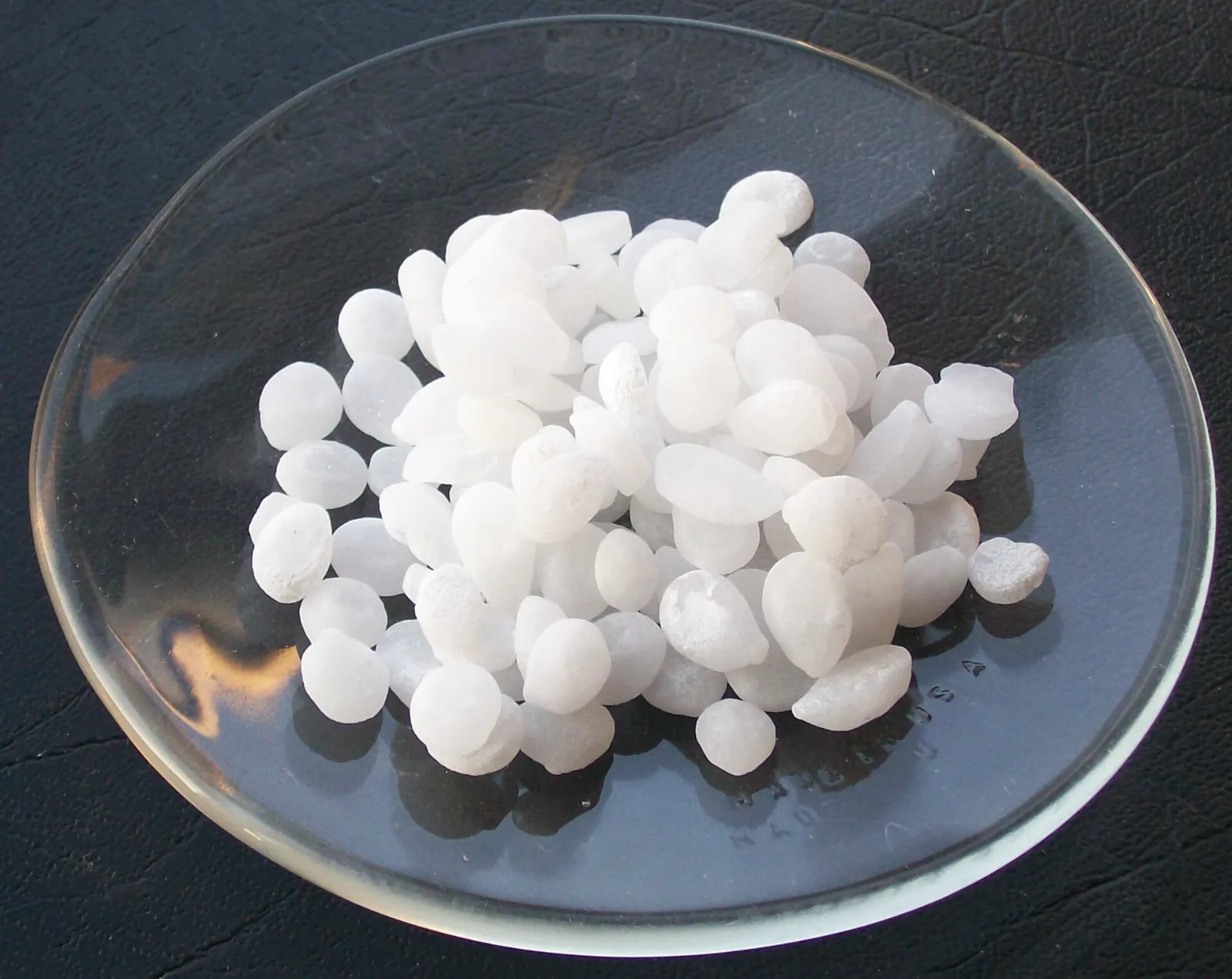
You see the figure on the bag: 98 per cent, 99 per cent. The material looks much the same either way — white crystalline flakes. But one percentage point of purity conceals a severalfold difference in impurities, and that difference is irrelevant in some industries and goes straight to scrap in others. This article explains what the number actually measures and how to decide.
What the purity figure means
Purity is the percentage by weight of sodium hydroxide in the product, normally determined by acid–base titration. At 99 per cent, every 100 kg of product contains at least 99 kg of active material and at most 1 kg of everything else. At 98 per cent, that remainder becomes 2 kg.
The key point sits right there: one point of purity means twice as much non-NaOH. For a process sensitive to one of those impurities, that doubling is what decides the outcome.
What the one or two per cent consists of
Three compounds account for most of the impurity in flake caustic soda, each from a different source:
- Sodium carbonate (Na₂CO₃) — from caustic reacting with carbon dioxide in the air during production, packing or storage. It rises over time, and faster in an open bag.
- Sodium chloride (NaCl) — residual brine from the electrolysis cells. Its level depends above all on the production technology.
- Iron (as Fe₂O₃) — from corrosion of equipment in the concentration and melting stages, which run hot.
Why the production route matters more than the number on the bag
Two products of identical nominal purity can behave quite differently, because the mix of those impurities differs. The main factor is the chlor-alkali route:
- Membrane cell — keeps chloride in the product very low, and is the dominant route in newer plants.
- Diaphragm cell — leaves considerably more chloride and generally needs heavier evaporation to reach solid caustic.
So if your process is chloride-sensitive, asking “what is the purity?” is not enough. You need to see the certificate of analysis.
Which industry is sensitive to which impurity
The general rule is simple: wherever the impurity ends up in the finished product, meets a catalyst or a membrane, or affects colour and clarity, the higher purity is the safer choice.
- Textiles and mercerisation — iron yellows white cloth; chloride reduces evenness.
- Liquid detergents and personal care — clarity and colour are sensitive to iron and carbonate.
- Biodiesel and catalytic processes — carbonate and moisture form soap and cut transesterification yield.
- Ion exchange resin regeneration and boiler water — high chloride causes ion leakage and loss of resin capacity.
- Food and pharmaceutical use — beyond purity, the relevant grade certification and heavy metal control are mandatory.
By contrast, in traditional soap making, pulp cooking, effluent neutralisation, parts degreasing and industrial cleaning, these impurities make effectively no difference to the result, and reaching for higher purity only adds cost.
Comparing properly: on an active-ingredient basis
The common purchasing mistake is comparing price per tonne of product, when what you are actually buying is active material, not bag weight. The correct approach is one division:
Quantity to buy = your net requirement ÷ product purity
If you need 20 tonnes of pure sodium hydroxide a month, at 98 per cent you must buy about 20.4 tonnes and at 99 per cent about 20.2. Then compare price per kilogram of active material in each case, not price per tonne. If the price gap exceeds the purity gap, the lower grade is the better buy — provided your process is not sensitive to the impurities.
The questions worth asking
Purity is where the conversation starts, not where it ends. Three questions are more useful than “what is the purity?”:
- Will you supply the certificate of analysis for this batch, not an old sample sheet?
- What are the chloride and iron figures on it?
- How much does that figure move from one consignment to the next?
For most production lines consistency matters more than an extra point of purity, because you set your formulation against a number, and a number that moves upsets the settings built on it.
Our flake caustic soda is supplied at 98 to 99 per cent purity to the Iranian national standard ISIRI 364, in 25 kg bags, and the certificate of analysis for each batch travels with that consignment. Contact our technical specialists to check the fit with your process.
Comments 3
Our technical team usually replies within one business day.

Pariatur sunt anim sit eiusmod magna quis aliquip. Irure esse excepteur in id amet tempor aliqua, nostrud ex dolor cillum sint culpa est consectetur. Incididunt ut exercitation ea in dolore occaecat qui. Laborum adipiscing ut enim ullamco commodo reprehenderit eu cupidatat.
Lorem elit labore ad laboris consequat in fugiat. Non deserunt ipsum sed et minim nisi duis, voluptate nulla proident mollit dolor do dolore veniam ut aute velit.
Aliqua nostrud ex dolor cillum sint culpa est consectetur incididunt ut. Exercitation ea in dolore occaecat qui laborum adipiscing ut enim ullamco commodo reprehenderit eu?