
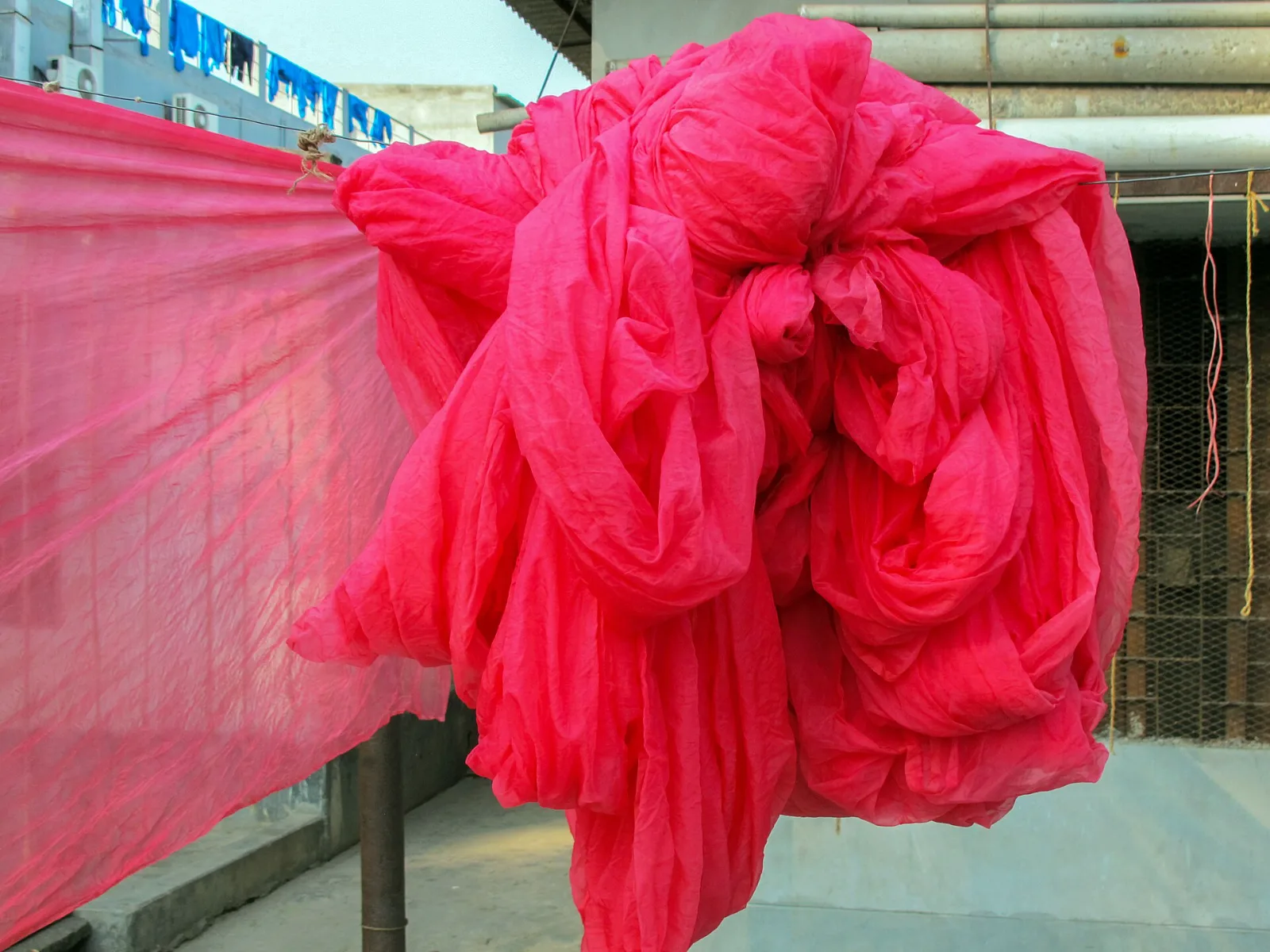
Mercerisation is the oldest industrial use of caustic soda in textiles, and still the single step that most determines how a cotton fabric looks and behaves. Its result, however, depends closely on three numbers: concentration, temperature and tension. This article explains what each one does, and why getting one wrong cancels out the other two.
What happens at fibre level
Raw cotton fibres have a flat, kidney-shaped cross-section and a natural twist, and their surface scatters light in all directions — which is why untreated cotton looks matt. Placed in concentrated caustic solution, the fibres swell, their cross-section rounds out and the natural twist unwinds. A smoother surface reflects light more evenly, and the fabric takes on lustre.
Something more significant happens in the crystal structure at the same time: cellulose converts from the Cellulose I form to the more stable Cellulose II. That change is irreversible, and it is what makes the new properties permanent.
The three key parameters
Concentration
The usual industrial window is a caustic solution of 18 to 25 per cent by weight, which textile mills normally express in degrees Baumé — roughly 20 to 30 °Bé. Below about 10 per cent the fibres do not swell enough and the mercerising effect is essentially lost. Going above the usual window buys no further benefit and only raises caustic consumption and recovery costs.
Temperature
This is the parameter most often misunderstood. Unlike most dyeing processes, mercerisation works better cold; the usual range is 15 to 25 °C. The reason is simple: fibre swelling is greater at low temperature. If the bath warms up — as it naturally does during operation, since diluting caustic is exothermic — the mercerising effect falls away. Mills without cooling therefore get weaker results by the end of a shift.
Tension
If the fabric is not held under tension during treatment, the fibres swell but then contract as they dry, and no lustre develops. This is called slack mercerisation; it is sometimes done deliberately to raise stretch, but where lustre is the aim it is simply a mistake. Tension must be controlled in both warp and weft directions.
Why caustic quality matters here
In mercerisation the impurities in the caustic land directly on the finished product:
- Iron stains white and pale fabric yellow, and will not be hidden by subsequent dyeing.
- Chloride affects the evenness of uptake and the behaviour of the bath.
- Carbonate makes the effective caustic concentration lower than the figure you measured, without your noticing.
This is why bath concentration should be monitored periodically, and why the certificate of analysis for each consignment matters more than the purity figure printed on the bag.
After the treatment
Once the contact time is over, the fabric must be washed while still under tension to remove excess caustic, then neutralised with a weak acid and rinsed again. Alkali left in the cloth damages the fibre and disrupts the dyeing stage that follows.
The dilute caustic that comes off is not normally discarded: larger mills recover it by evaporation and return it to the bath, which cuts both cost and effluent load.
What you get
Properly mercerised fabric is more lustrous, stronger in tensile terms, takes dye more deeply and more evenly, and is dimensionally more stable — it shrinks less. The saving on dyestuff is also material, since less colourant is needed to reach the same depth of shade.
The certificate of analysis for each batch is available on request, and our technical specialists are reachable during working hours to help you match the grade to your process.

Comments 0
Our technical team usually replies within one business day.