
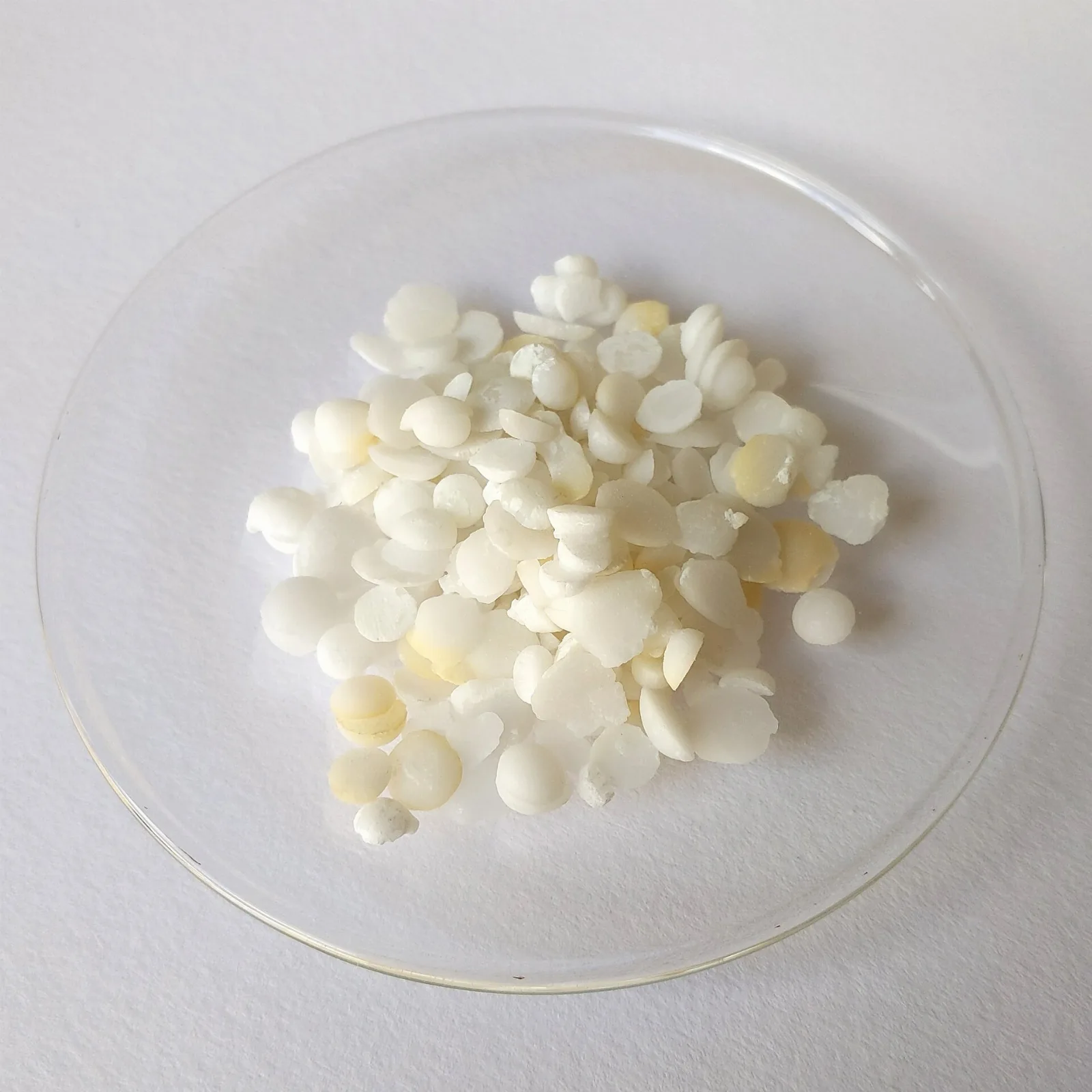
Caustic soda flakes are simply solid sodium hydroxide (NaOH): thin white flakes used in soap making, paper, textiles, water treatment and oil refining. But where do those flakes come from? This article walks through the production route step by step, from brine to the 25 kg bag, and explains which figures to check when you judge quality before buying.
What are caustic soda flakes made from?
The raw materials are nothing more than common salt (sodium chloride) and water, and the main energy input is electricity. In the process known as chlor-alkali, an electric current is passed through concentrated brine and three products come out at the same time: caustic soda, chlorine gas and hydrogen gas.
2NaCl + 2H₂O → 2NaOH + Cl₂ + H₂
That is why caustic soda and chlorine are always produced together, and why the price of power makes up a large share of the cost of caustic soda: membrane technology uses roughly 2 to 2.5 MWh of electricity per tonne of NaOH.
Three electrolysis technologies: mercury, diaphragm and membrane
Caustic soda used to be made in mercury or diaphragm cells. Mercury cells gave very pure caustic but carried a risk of mercury pollution and have been phased out, especially since the Minamata Convention. Diaphragm cells produced a weaker liquor with more salt in it.
Today membrane technology is the standard: an ion-exchange membrane lets only sodium ions through, giving clean caustic soda with very little chloride and lower energy use. The difference shows up on the certificate of analysis too; Iranian national standard ISIRI 364 caps mercury at 0.2 mg/kg and chloride at 0.06%.

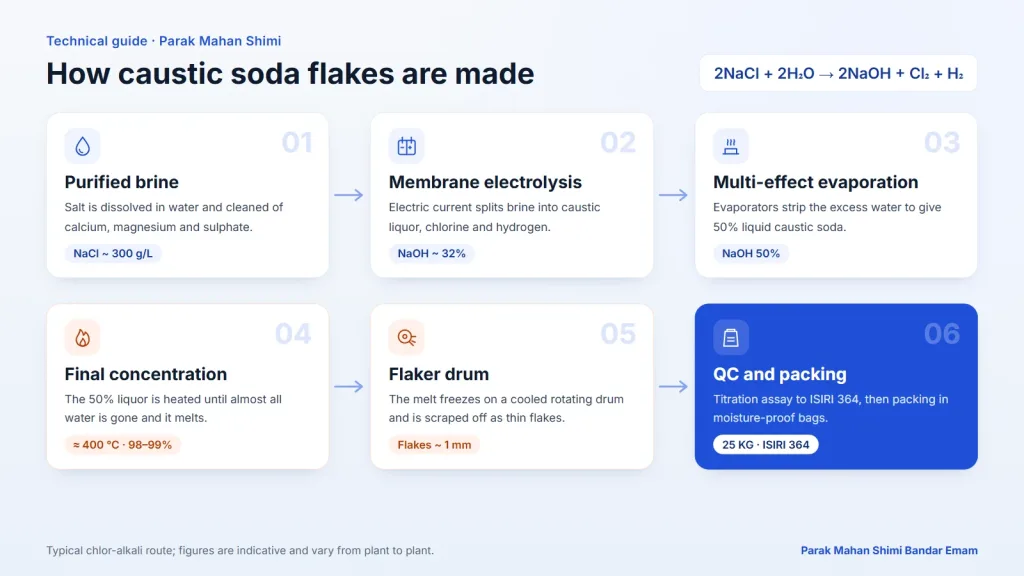
Caustic soda flake production, step by step
1. Brine preparation
Salt is dissolved in water to a near-saturated solution of about 300 g/L. Calcium, magnesium and sulphate must be removed to very low levels, because they scale the cell membrane and shorten its life.
2. Electrolysis
In a membrane cell, chlorine forms at the anode while hydrogen and caustic soda form at the cathode. The caustic leaving the cell is a solution of about 32%.
3. Evaporation
The 32% liquor is concentrated in multi-effect evaporators to 50% liquid caustic soda, the product sold by tanker to large consumers.
4. Final concentration and melting
To make solid caustic, almost all the remaining water has to go. The 50% liquor is heated to about 400 °C in concentrators usually heated by molten salt, becoming a 98–99% melt (pure sodium hydroxide melts at about 318 °C). At this temperature caustic is extremely aggressive, so this section is built from nickel alloys to keep iron out of the product.
5. Flaking
The melt is fed onto the outer surface of a rotating steel drum cooled with water from inside. It freezes into a thin layer that a knife scrapes off as flakes about one millimetre thick, which is where the product gets its name.
6. Quality control and packing
The flakes must be packed straight away, because sodium hydroxide absorbs moisture and carbon dioxide from the air: moisture makes it cake, and carbon dioxide turns part of it into sodium carbonate, lowering purity.
How is the purity of caustic soda flakes measured?
The key quality figure is the NaOH content by weight, and the simplest way to measure it is an acid-base titration. The method given in the Parak Mahan Shimi catalogue is:
- Dissolve 4 g of caustic soda in 100 ml of water.
- Transfer 25 ml of the solution into a 250 ml Erlenmeyer flask.
- Add one drop of phenolphthalein indicator; the solution turns pink.
- Titrate with 0.1 N hydrochloric acid until the pink colour disappears.

Impurities are measured separately and compared with the limits of ISIRI 364. Some key figures for Parak Mahan Shimi caustic soda flakes:
| Parameter | ISIRI 364 limit | Typical result |
|---|---|---|
| Sodium hydroxide (NaOH) | min 98% | 98.5% |
| Carbonate (Na₂CO₃) | max 1.0% | 0.5% |
| Chloride (NaCl) | max 0.06% | 0.01% |
| Iron (Fe) | max 30 mg/kg | max 7 mg/kg |
| Mercury (Hg) | max 0.2 mg/kg | nil |
The full analysis, including sulphate, silica, aluminium, heavy metals and arsenic, is on the caustic soda flakes product page.
Packaging: why a three-layer bag?
Parak Mahan Shimi caustic soda flakes are packed in 25 kg woven polypropylene bags with a moisture-proof polyethylene liner and double stitching. The liner keeps air away from the product, and the woven layer gives the strength needed for handling and stacking on pallets. The product is also delivered palletised and in container loads of up to 26 tonnes.

What to check when buying caustic soda flakes
- Appearance: flakes should be white, dry and free-flowing. Lumps or dampness mean moisture got in during storage or through poor packing.
- Certificate of analysis (COA): ask for the COA of the actual batch and compare the NaOH and carbonate figures with what your process needs.
- Label: the producer’s name, grade, weight and corrosive hazard symbol should be printed on the bag.
- MSDS: get the safety data sheet before delivery and share it with your storekeepers and operators.
- Bag condition: a torn bag or open seam both lowers purity and creates a risk of skin contact.
Caustic soda flake production at Parak Mahan Shimi
Parak Mahan Shimi Bandar Emam began producing caustic soda flakes in 2011 and, after expanding its production line in 2015, reached a capacity of 45 tonnes per day. The plant is in Phase 1 of the Mahshahr chemical zone and runs three shifts around the clock. Product purity is 98–99%, in line with national standard ISIRI 364.
Safety warning: caustic soda flakes are highly corrosive. Wear resistant gloves, safety goggles and protective clothing, and always add caustic to water, never water to caustic: dissolving it releases heat and the solution can splash.
For today’s price, a certificate of analysis or shipping arrangements, fill in the quote request form or contact us.

Comments 0
Our technical team usually replies within one business day.